The Unsung Hero of Fire Safety: Understanding the Conventional FACP
Imagine you own a cozy, bustling coffee shop. You have the smell of roasted beans, the hiss of the espresso machine, and happy customers chatting. You’ve done everything right to keep your business safe: you have fire extinguishers and clear exit signs.
But there is one piece of equipment on the wall near the back door that you rarely think about. It’s a metal box with a few blinking lights.
This is the Conventional Fire Alarm Control Panel (FACP).
If you are a building owner or a facility manager, you might have heard this term thrown around by contractors. It sounds technical and intimidating. But it doesn't have to be. Let’s break down exactly what this device is, how it works, and why it is the brain of your fire safety system, using our coffee shop story.
The "Zone" Detective
One afternoon, a customer accidentally knocks over a candle near the restrooms. Smoke starts to rise.
In a massive, complex skyscraper, a sophisticated computer might pinpoint the exact smoke detector that triggered. But in your coffee shop, you have a Conventional Fire Alarm System.
Here is how the Conventional FACP handles the situation:
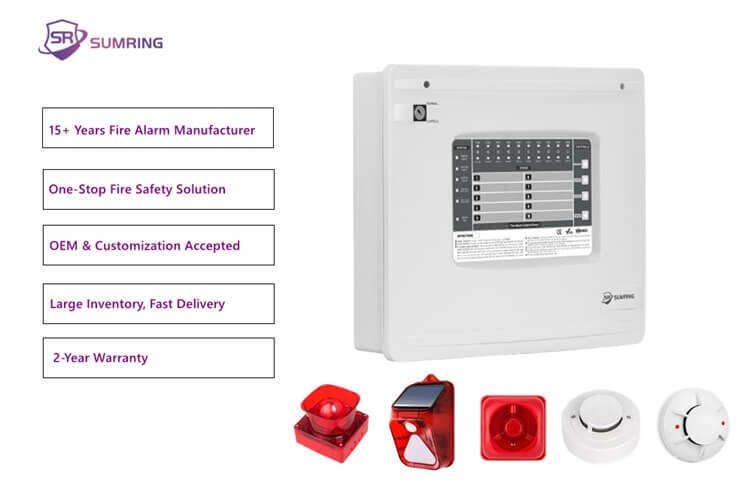
- The Trigger: The smoke detector in the restroom senses the smoke. It closes an electrical circuit.
- The Signal: This signal travels down a specific wire back to the main panel.
- The Zone: The panel doesn't know exactly which detector went off (it’s not that smart), but it knows which Zone the wire belongs to.
- The Alert: The panel lights up the LED labeled "Zone 2: Restrooms" and sounds the building's sirens.
In simple terms: A Conventional FACP divides your building into "Zones" (like the Kitchen, the Lobby, the Hallway). When an alarm goes off, the panel tells you where to look, but not exactly which device triggered it.
Why "Conventional"?
You might wonder, "Why is it called conventional?"
Think of it like a standard light switch versus a smart home app. A Conventional FACP is the standard, reliable switch. It uses simple wiring to connect detectors to the panel. It is robust, time-tested, and perfect for smaller buildings like schools, shops, and small offices.
It doesn't need complex coding or expensive software. It relies on simple electrical paths. If the path is broken (a wire is cut) or closed (a detector is triggered), the panel knows immediately.
The 3 Main Jobs of an FACP
Using our story, we can see the panel has three main responsibilities:
- Monitoring (The Watchdog): It constantly checks the wiring. If a wire gets cut or a detector is removed, the panel shows a "Fault" or "Trouble" light. It’s telling you, "Hey, I can't see Zone 3, please fix me."
- Alerting (The Alarm): When it receives a signal from a smoke detector or a manual pull station, it activates the bells, horns, and strobe lights to wake everyone up.
- Control (The Commander): In more advanced setups, the FACP can talk to other systems. For example, it can tell the air conditioning to turn off so it doesn't blow smoke around, or it can unlock the electronic doors to help people escape.
Is a Conventional FACP Right for You?
If you are managing a small-to-medium-sized building, a Conventional Fire Alarm Control Panel is often the most cost-effective choice.
It is perfect if:
- You have a smaller budget.
- Your building is relatively small (a "Zone" is easy to search visually).
- You want a system that is easy to install and maintain without specialized computer technicians.
Conclusion
The Conventional Fire Alarm Control Panel might look like a boring metal box, but it is the heart of your safety strategy. It takes the panic out of an emergency by instantly telling you where the problem is, ensuring that help arrives at the right place, at the right time.
Latest posts
-
 The Heartbeat of Safety: Why Every Building Needs a Reliable Fire Alarm Control
Do you like ?0
Read more -
 The Critical Importance of Fire Alarm Control Panels: A Lesson from Fire Tragedy
Do you like ?0
Read more -
 A Small Kitchen Fire: How the SR-P03 Fire Alarm Control Panel Stopped Disaster
Do you like ?0
Read more -
 What Are the Two Types of Fire Alarm Control Panels?
Do you like ?0
Read more -
 How to Check Your Fire Alarm Control Panel ?
Do you like ?0
Read more -
 How a Fire Alarm Control Panel Works
Do you like ?0
Read more
Search
Hot Product